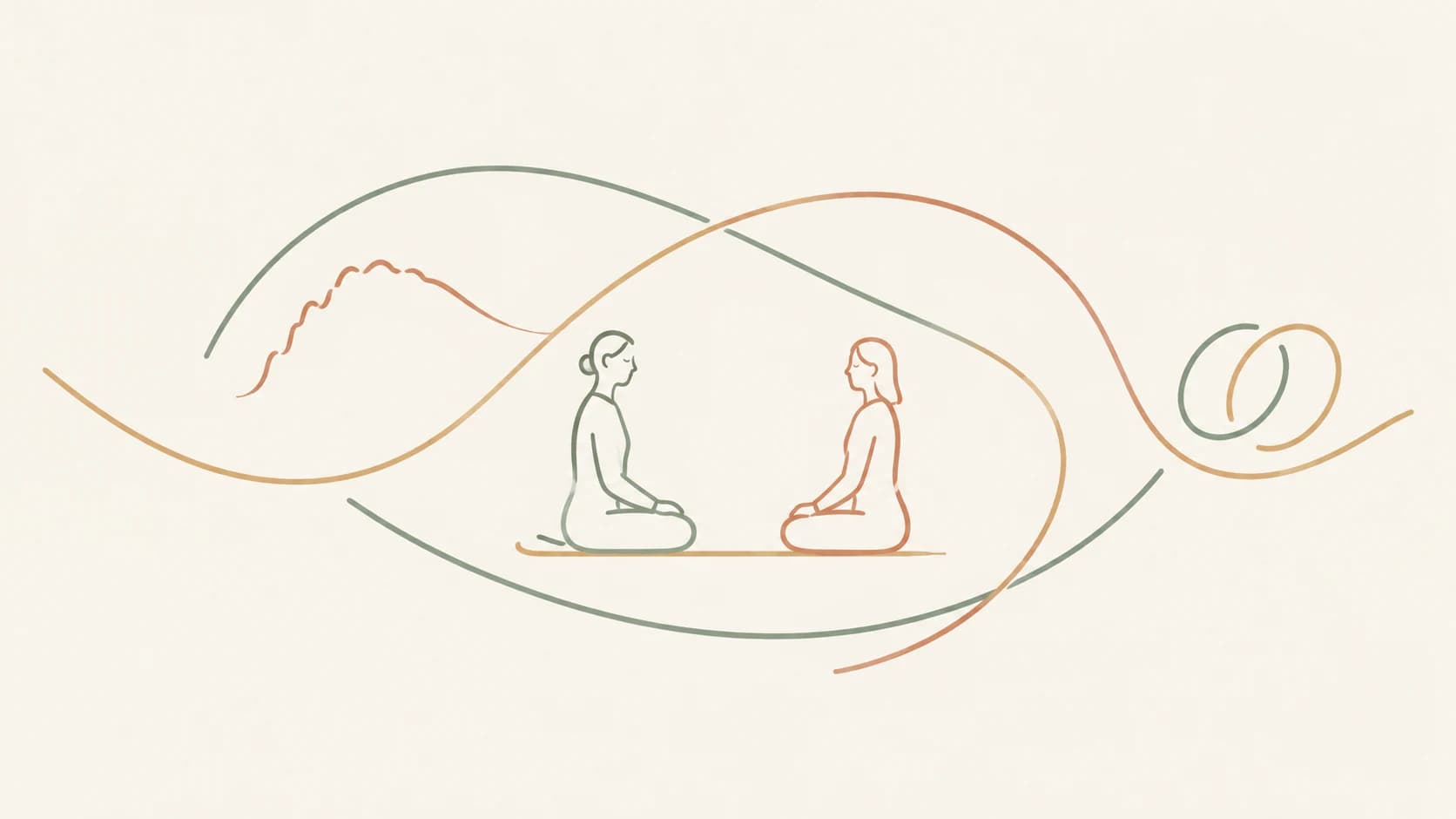
Halfway through a session, something comes up: tears, a shiver that won't stop, a silence that fills the room. For a second you freeze: stop, or keep going? That second is normal, and it is where holding space begins, whatever your work: touch, cards, breath, words or something else.
To hold space is to stay with what someone is going through, without judging it, fixing it or taking it over. When this is your work, it also means staying in yourself: keeping part of your attention on yourself.
Here is how it looks in a session, how to stay steady, where it ends, and what to keep between sessions.
Isn't holding space just listening?
Listening is part of it, but holding space is also about what you don't do. You don't try to fix things, and you don't give advice unless someone asks.
For me, it also means watching what happens without judging it. I don't judge the person, and I don't judge myself either.
It doesn't mean the client leads and I follow. I start something, listen closely to what comes up, and let it be. Then the session grows from whatever comes from them, as long as it helps them.
If the session turns somewhere they didn't want to go, I do what feels right in that moment. None of this is criticism, or a silent verdict in my head. It's closer to acceptance — even love — than to judgment.
Heather Plett's 2015 blog post made the phrase popular. One of her tips is "Don't take their power away." The decision stays with the person.
You will rarely say "I'm holding space for you" to a client. One psychotherapist was blunt about it: "If you have to say you're holding space I don't think you're really holding space…"
Where does "holding space" come from?
The phrase spread through a story about a professional at work, years before an interview about the film Wicked made it a meme. In 2015 Heather Plett wrote about Ann, a palliative care nurse who supported the family while Plett's mother was dying at home.
Ann "taught us how to inject Mom with morphine when she became restless" and offered to do the hard tasks. Plett's summary was simple: "She was holding space for us."
The post spread, and many people now roll their eyes at the phrase. A year later Plett herself wrote that it had become "a throw-away phrase, not unlike 'thoughts and prayers'…"
She says she didn't invent it. Facilitators, the people who run large meetings, used it before her: Harrison Owen's 1990s guide asks them "to hold space/time". Nobody knows exactly where it began.
What does holding space look like in a session?
In a session, holding space means you start something (a touch, a card), notice what comes up, and follow what comes from the person.
Once someone tensed up when I touched their shoulder. I let go and asked them to notice where exactly in their body it had tightened. Then I took their hand, because touch there worries people less, and made sure that felt fine.
From there I looked for the point where "fine" turns into "unpleasant". They had agreed to this and knew they could stop me any time: the point was for them to notice their "no" and say it.
I stayed at that point until they noticed two things: it was unpleasant, and they were putting up with it in silence.
When they said "no" out loud for the first time, they felt in control, and they felt they could trust themselves. The session went on from there. We got that far only because I was quiet inside, and they had room to be however they were.
Tears are expected in my sessions, and we talk about that before we start. That talk about how I work is part of the first session with a new client. Tissues are always within reach.
What I do next depends on the session: I may stop, lift my hands, keep going or go deeper. Sometimes I simply stay and hold the person, if they want closeness. Sometimes I step back.
If the feelings get too strong for someone, we stop. We stay together for a few minutes until the wave settles. Usually relief comes, because everyday life rarely lets those feelings out.
Practitioners even disagree about whether to offer a tissue. Susan Coffey's massage-school instructor told her not to offer one to a crying client. "She said that by giving a tissue we are telling the person to stop crying."
Another massage therapist was taught the opposite: "Offer a tissue, and water if they would like."
My answer is somewhere in between. The tissues are nearby, but I don't hand them over automatically.
Other practitioners look for small ways to give the person room. One massage therapist pauses to ask: "Do you want a moment, or for me to continue the massage?"
Another tells the client at the end that no one else is booked for a while, so they can take a few extra minutes.
Tarot reader Liz Worth reminds clients: "You know your life better than I do, and you know what you need better than I can tell you."
The same goes for coaches, reiki practitioners, doulas and anyone else who works one to one.
How do you hold space without carrying it?
You hold space without carrying the client's feelings by keeping part of your attention on yourself, and the rest on the client. Julia is a colleague of mine who works with touch. Her starting point is empathy.
For her, feeling for someone isn't the same as taking their feeling on as her own. She keeps her own calm. That doesn't mean a blank face or switching off.
She can see what the client is going through and care about them, but the feeling isn't happening inside her. Her anchor, the thing that keeps her steady, is in her body.
In her training they had a name for this: my spine belongs to me. It means part of her attention always rests on some place in her own body. She keeps her attention split roughly 50/50: half on herself and half on the client.
For her, the most objective anchor is the weight of her body on the chair. Her back may tense up when a client feels something strong. But the feeling of her muscles and bones pressing into the seat is hers.
Nothing the client feels changes that pressure. She privately calls it the butt factor.
Julia noticed something in hands-on work. When a client starts shaking and she puts all her careful attention on the shaking, it gets stronger. When she brings her attention back to herself and simply stays, the shaking passes.
In my own work, I mostly watch how I respond to the person: where my own feelings answer in my body. Quite often, what I feel matches what the client describes later. Practitioners like to explain this with mirror neurons.
When I get quiet and just watch, without thoughts or judgments, I feel more deeply. The person is caught up in their feelings, and I stay, feel what they feel, and know that all is well. Somehow that calm seems to reach them.
My own anchor is breath. When something starts to take me over, I slow my breath and stay with the breathing, while noticing what else is happening. Slowing down relaxes me, and it seems to relax the person too.
If a feeling in you responds and you get lost in it, suddenly there are two clients in the room.
Psychotherapists describe something similar. Shari Geller defines therapeutic presence as being "in contact with one's integrated and healthy self" while staying open to the moment. Put simply: in touch with yourself, and open to what is happening now.
Your anchor doesn't need touch or any special posture.
If you read cards at a table, it can be the chair. Standing at a massage table, it can be your feet. On a video call, it can be your breath.
Where does holding space end?
Holding space ends where solving problems and giving advice begin. Cal Cates put it in one line in the magazine Massage & Bodywork: "Listening is never outside your scope. Solving and advising often are."
Exactly where your scope of practice ends depends on your profession and where you work. Staying inside it doesn't mean being cold. In a later article, Cates says it means "being present without trying to fix, analyze, or counsel."
In one discussion among massage therapists, most replies agreed: accept what the person shares, and don't push for more. One wrote that if a client opens up, you should "hold space, give them options for privacy or to continue". The same reply suggests having psychotherapists' contact details on hand.
Asking "do you want to talk?" can feel like an intrusion. One massage therapist, imagining being the client, wrote that being pushed to share their struggles "would honestly feel violating and manipulative to me."
Cates also warns about the opposite mistake: sending the client away too fast. Asking "Do you have a therapist?" too quickly can sound like "Please take your feelings elsewhere."
Instead, Cates suggests saying something like: "That sounds hard/rough/difficult. I'm glad you feel safe enough to share that with me."
Sometimes the right step is to refer the client to a counsellor or psychotherapist. Cates lists when to do that, including:
- "Clients ask for specific psychological advice or therapy"
- "You notice signs of serious mental health crisis, including thoughts of self-harm"
- "Clients repeatedly process the same traumatic content without progress"
- "You feel consistently overwhelmed by a client's emotional needs"
How do you carry a client's story between sessions?
Practitioners carry it in two opposite ways: some try not to think about clients between sessions, and others make a point of remembering. After 21 years as a massage therapist, David Lobenstine writes: "my aim is to not think about my clients between their sessions."
Psychotherapists lean the other way. PACFA, an Australian federation of psychotherapists and counsellors, quotes a training webinar in its guideline on session notes. "Remembering previous sessions is a basic demonstration of respect for our clients."
Julia finds that when she stays in herself, the client leaves and takes their story with them. She isn't lying awake wondering how they are.
I don't try to think about clients between sessions, and I don't stop myself from remembering them either. When a thought about someone comes up on its own, I take out my phone and dictate it for our next session.
I used to keep these thoughts in apps not made for client work, and couldn't find them later. Typing was worse: I'd think about the words and lose the details. When I speak, I keep every detail.
To see what goes into such a note, look at this session notes template.
If something comes up for someone in your next session, notice where your attention is. Bring part of it back to yourself: to your breath, your weight on the chair, or your feet on the floor.
If a client stays on your mind that evening, tell someone who will listen without judging.
Your notes can hold what you need for next time, so you don't have to keep it in your head. That is what HoldSpace is for, and why it has that name.
After a session you dictate a note, and AI sorts it into sections. It sits in the client's timeline, next to their sessions.
Speak your notes after a session and find them before the next one.Free plan: 30 minutes of dictation, 10 AI-sorted notes and 5 clients.
FAQ
What's another way to say "hold space"?
Plain words work: be with someone, stay with what is happening, listen without judging, let them decide what they share. With clients you may never need the phrase at all.
Can you hold space online?
Yes, though some of it is harder when you're not in the same room. Death doula Adriene Jenik put it this way in an interview: "That can be approximated on zoom or on the phone, but it's harder. Because part of it is just being quiet."
Your anchor comes with you. Your breath and your weight on the chair are there on a video call too.
Is holding space the same as therapy?
No. Listening is your work, while psychological advice belongs to a counsellor or psychotherapist.
The section Where does holding space end? shows where that line runs. Why we say "client" is in this piece on the word.
Sources
- Cates, C. (2020, November/December). Scope of Practice: What It Is and Why It Matters. Massage & Bodywork (ABMP). Retrieved 26 October 2026. abmp.com/massage-and-bodywork-magazine/issues/novemberdecember-2020/scope-practice-what-it-and-why-it-matters
- Cates, C. (2025, Autumn). Beyond the Referral: Staying Present with Clients' Emotional Needs. Massage & Bodywork (ABMP). Retrieved 26 October 2026. abmp.com/Massage-and-Bodywork-Magazine/Issues/autumn-2025/beyond-referral
- Coffey, S. (2017, September/October). The Art of Holding Space. Massage & Bodywork (ABMP). Retrieved 26 October 2026. abmp.com/massage-and-bodywork-magazine/issues/septemberoctober-2017/art-holding-space
- Geller, S. M. (2013). Therapeutic presence as a foundation for relational depth. In Knox, Murphy, Wiggins & Cooper (Eds.), Relational Depth: New Perspectives and Developments (pp. 175–184). Basingstoke: Palgrave. sharigeller.ca (author's PDF)
- Jenik, A. (2020, 15 July). A Great Mercy: A Death Doula on Grief and Transformation. Interviewed by K. Eisele. Borderlore, Southwest Folklife Alliance. Retrieved 26 October 2026. borderlore.org/a-great-mercy-a-death-doula-on-grief-and-transformation/
- Lobenstine, D. M. (2025, Winter). Do Less. Focus More. Care Carefully. Massage & Bodywork (ABMP). Retrieved 26 October 2026. abmp.com/massage-and-bodywork-magazine/issues/winter-2025/do-less-focus-more-care-carefully
- McCusker, K. (2024, 28 November). ‘Holding space’: Wicked has made the term famous. But what does it mean? The Guardian. Retrieved 26 October 2026. theguardian.com/film/2024/nov/28/holding-space-wicked-has-made-the-term-famous-but-what-does-it-mean
- Owen, H. (early 1990s). Open Space Technology: A User's Guide. Abbott Publishing. Retrieved 26 October 2026. elementaleducation.com (PDF copy)
- Plett, H. (2015, 11 March). What it means to "hold space" for people, plus eight tips on how to do it well. Retrieved 26 October 2026. heatherplett.com/2015/03/hold-space/
- Plett, H. (2016, 22 August). Holding liminal space. Retrieved 26 October 2026. heatherplett.com/2016/08/holding-liminal-space/
- Plett, H. (n.d.). About Me. Retrieved 26 October 2026. heatherplett.com/about-me/
- r/MassageTherapists (2025). Handling the situation when a client has an emotional release. Reddit. Retrieved 19 October 2026. reddit.com/r/MassageTherapists/comments/1lpbych/
- r/MassageTherapists (2025). Emotional Release During a Session — Should I Have Said Something? Reddit. Retrieved 19 October 2026. reddit.com/r/MassageTherapists/comments/1o2g6cn/
- r/therapists (2024). Hey fellow clinicians, what therapy words or phrases annoy you???? Reddit. Retrieved 19 October 2026. reddit.com/r/therapists/comments/1hcplh4/
- Rao, K. (2023). Case notes and record keeping in therapy. eiseEducation webinar. Quoted in PACFA (n.d.), Writing session notes, Psychotherapy and Counselling Federation of Australia, Good Practice Guidelines. Retrieved 26 October 2026. pacfa.org.au (PDF)
- Wikipedia contributors (n.d.). Holding space. Wikipedia. Retrieved 26 October 2026. en.wikipedia.org/wiki/Holding_space
- Worth, L. (n.d.). How much advice should a tarot reader give to their querents? Retrieved 26 October 2026. lizworth.com/blog/how-much-advice-should-a-tarot-reader-give-to-their-querents