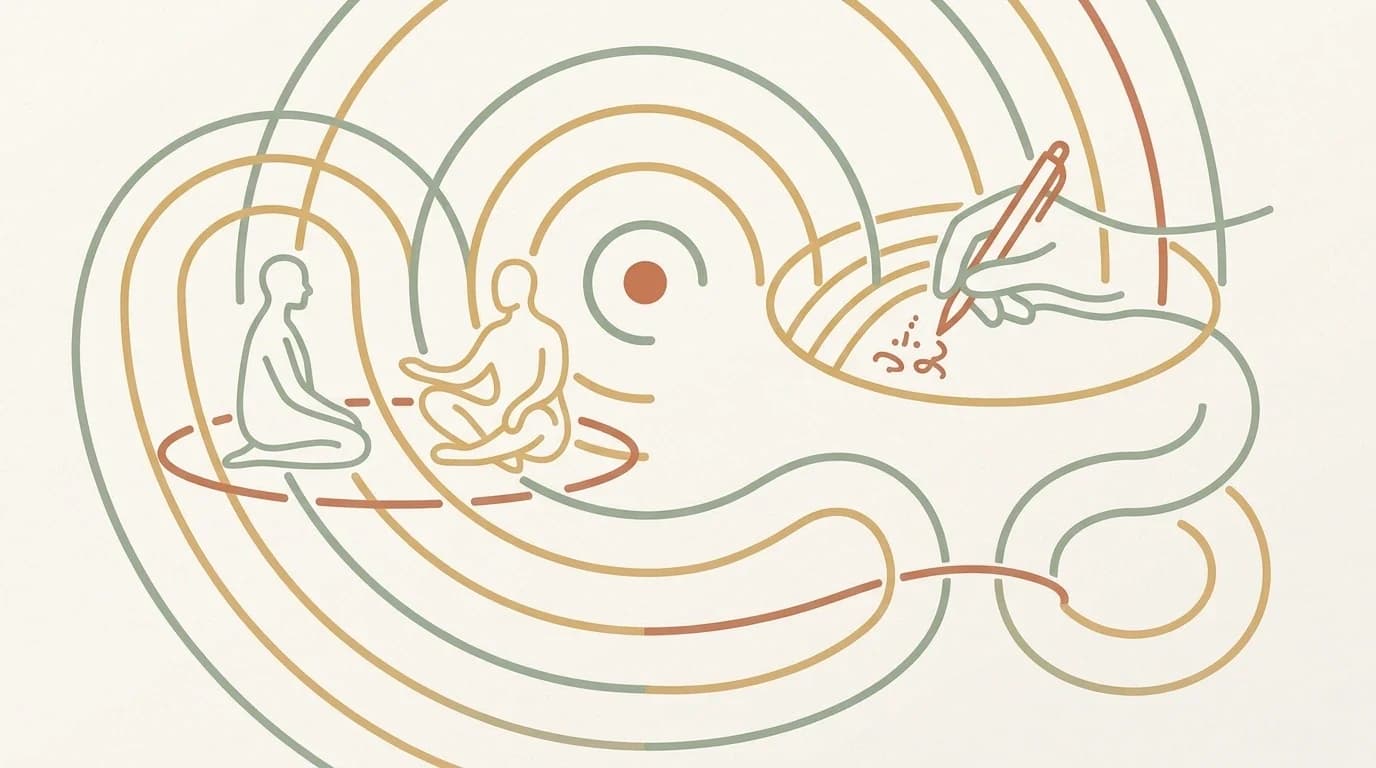
The session ran long, the door has closed, and you sit down to write. Search for a session notes template, or one for massage therapy, and you mostly find clinical forms. They have boxes for range of motion and billing codes.
Here is a template for practitioners who work one to one, in bodywork, reiki, tarot, coaching or anything else. It gives you an order to follow: walk back through the session from the start, and write as you go.
Date · who · which session (first, fifth…)
- Before you started. What they came with and what you talked about, in words close to theirs. What they asked for, and anything they asked you to avoid.
- Since last time. What has changed, including anything you noted to watch last time. Skip it on a first session.
- How it went, in order. What you did or said, and what happened.
- What stood out. What surprised you or might help them, even if you are not sure why yet.
- For yourself. What was hard, what you learned, what you want to try again.
- What they said at the end. In their words.
- Next time. What to check, what is still open.
…and anything else that stayed with you.
If you have nothing for a line, skip it. Three sentences are a note too. You can also speak them instead of typing.
Why the templates you find don’t fit
Most session and client notes templates you find are SOAP notes (Subjective, Objective, Assessment, Plan), written for someone who checks your work. The American Massage Therapy Association describes its SOAP form as a way “to document a client’s condition and progress”, also “useful when communicating with insurance companies”.
Your reader is you, the evening before the next session. Boxes make you decide mid-thought where each thing goes. What was hard for you, or what you meant to try, fits no box and quietly drops out.
When you follow the session in order, you never decide where a thing belongs. You only remember what came next. Whether you need SOAP at all is covered in session notes without the clinic.
How to write session notes: walk through the session in order
To write session notes, go back through the session from the start and note each thing as you come to it. You can type the note or say it out loud. What matters is the order: the conversation before, then the work, then the end.
My sessions are long, so afterwards I sit for a few minutes and go back through the session, the way it happened. I start with the conversation before we began. Then I note anything from the session that might help the person.
I also write down whatever felt important, whether or not it matters for this session. A detail that seems unimportant tonight may be what you come back to in a month.
Going back through the session from the start is what helps me remember. When I reach the moment something shifted, what I noticed there comes back with it. If I were sorting things under headings, I doubt that small moment would turn up.
If you speak the note, talk the way you would replay the session to yourself on the way home. Pauses and half-sentences are fine. You can tidy it tomorrow, or leave it as it is.
My notes are only for me anyway, so they never need to look neat. Between visits, my memory lets the small details go, and the note keeps them.
On a first session, also note why the person came, in their own words. There is more on that first meeting in your first session with a new client.
An example session note
Here is the kind of note I write after a long bodywork session. I put it together for this article on the shape of my own notes; the person and the details are invented.
Long session. Before we started she talked about her mother being in hospital; she hadn’t slept well all week. We began with breathing together and eye contact. She cried a little and said it was relief.
Back and shoulders guarded at first, the left side more. During the belly work she went completely soft. Deep work along the side of the neck connected to the tension between her shoulder blades, and both let go together. Good one; explore this more next time.
She wanted to make a sound and held it back; I offered a pillow, and she let it out. After: “I didn’t have to hold myself together for the first time in weeks.” Hard to read her body today, she barely moved, but she was present the whole time.
It has no headings, yet most of the template is there: what she came with, the work as it went and what stood out. Her words at the end are there too, and what was hard for me. There are no scores and no codes, and nothing is written for anyone else.
A month from now, three lines will matter most. First, the neck and the shoulder blades let go together, and the note says to explore this more next time. So the next session already has a place to start.
Second, her words at the end tell you what state she was in when she left. Third, “hard to read her body today” tells you to watch more closely next time, or simply to ask.
The same order works after a tarot reading. Here is how a reader’s note might look; it is invented too.
Third reading: she came asking whether to leave her job, and has dreaded Mondays since her team changed in the spring. What we kept coming back to: she seems to have decided already and is waiting for permission. At the end she said, “I’ll tell my partner this weekend, out loud.” Next time: ask how that conversation went.
What if your sessions don’t look like this?
This order works for any one-to-one session. Only the length changes, and what you do in the middle. If you see many people a day for short sessions, three sentences will do: what they came with, what happened, what comes next.
In tarot and astrology, the middle of the session is the reading. The reading stays in your own tools, from a spread journal to chart software. Your note keeps what surrounds it: what you talked about before, what the person took away and what to check next time.
Many reiki session notes templates come with a chakra checklist. You can leave it aside and write what you noticed and what the person told you. Coaching follows the same order, with the conversation in the middle.
Whatever your work, a session starts and ends in much the same way. Someone arrives with something and leaves with something else, and your note follows them the whole way.
The one exception: if your work centres on a health condition with a plan, or your licensing board sets a format, use your board’s format. Washington, for one, asks for four extra items “for massage therapy where the focus is on treating a health condition”. See when a clinical format fits.
Before the next session: read it all the way through
Before the next session, open the note and read the whole of it. I read mine in full to get back into how the last session felt. Reading it takes me back to the state the person was in then.
When they walk in, it is easier to see what has changed. I look at how far they have come with what we noted last time. Whatever I find goes into the next note, under the template’s second line, Since last time.
Read the note before they arrive, while the door is still closed. That way, the first minutes in the room are all theirs.
The note you write tonight is the one you will read next time. When the door closes after your next session, before you pick up your phone, start at the moment they arrived.
Can you speak the note instead of typing it?
Yes. Talk through the session from start to finish, and HoldSpace turns your speech into a text note on the client’s timeline. The audio itself is not kept.
To see what this looks like, read why we built HoldSpace. The plans are on the pricing page.
You can keep the note the way you said it; the order you walked through is already there. If you want it tidier, AI sorts what you said into sections, with no preset fields.
The AI is told to keep every detail and to add nothing you did not say. Your own version stays in the note’s history.
Structure your next note by voiceFree plan: 30 minutes of voice and 10 AI structurings a month, and 5 clients.
FAQ
Can you give an example of a massage therapy note?
Yes: the example above is the kind of note I write after a long bodywork session, in the order the session went. It has no SOAP headings. It runs from the conversation before the work to the client’s words at the end and what was hard for me.
What should you avoid writing in session notes?
Leave out claims about a condition, its cause or its result; other people’s words about the client; and guesses written down as facts. A hunch is fine when you mark it as a hunch. The longer answer is in what should stay out of the note.
Do you need a separate template for reiki or tarot sessions?
No: the order is the same, and only the work in the middle of the session changes. For reiki, write what you noticed and what the person said. For tarot, write what you talked about and what they took away.
Sources
- American Massage Therapy Association (n.d.). SOAP Notes. Forms & Templates. Retrieved 9 October 2026. amtamassage.org/resources/forms-templates/soap-notes/
- Washington Administrative Code (2021). WAC 246-830-565. Washington State Legislature. Retrieved 9 October 2026. app.leg.wa.gov/WAC/default.aspx?cite=246-830-565